
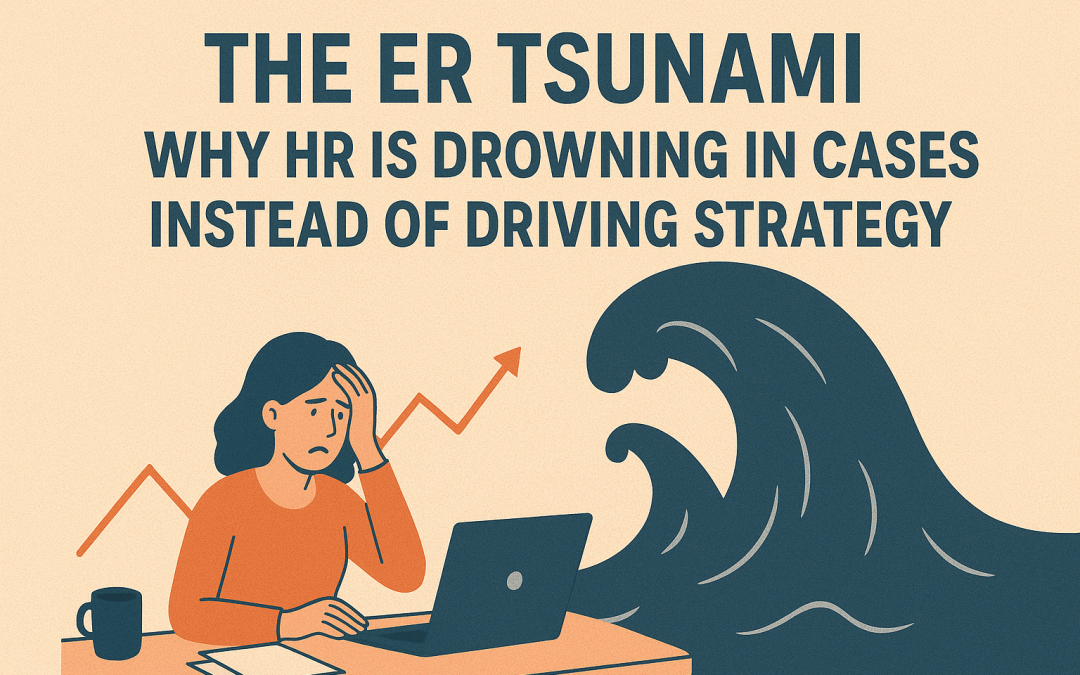
The Employee Relations Crisis: Why HR is drowning in cases instead of driving strategy
Table of Contents
- The Perfect Storm: Why ER Cases Are Exploding
- The Hidden Cost: Strategy Suffocated by Compliance
- The PATH Forward: Practical Actions to Tackle the Tsunami
- The Leadership Imperative: Care as Strategy
- The Small City Advantage: Leading from the Middle
- Your Next 30 Days: The Quick Wins
- The Bottom Line: Humanising HR Again
- Resources and References
A seasoned HR Business Partner sits at her desk at 7pm on a Friday evening, her third late night this week. The strategic workforce plan she promised the Business Leader sits untouched while she navigates yet another complex employee relations case – the fourth this week alone. Sound familiar?
Across Adelaide boardrooms and Brisbane break rooms, from Perth’s mining offices to Sydney’s tech hubs, HR professionals are sharing the same exhausted refrain: “I barely have time for strategy anymore – I’m constantly putting out ER fires.”
The numbers tell a stark story. According to Sage’s 2024 HR Report, a staggering 95% of HR leaders find working in HR overwhelming due to excessive workload and stress, with 84% frequently experiencing stress and 81% reporting burnout. Even more telling, Frazer Jones’ analysis shows a 50% uptick in hiring for employee relations and industrial relations roles in Sydney compared to last year, with mining, financial services, and government being the biggest employers in this space.
Welcome to the ER tsunami of 2025 – and it’s reshaping everything we thought we knew about People & Culture work in Australia.
The Perfect Storm: Why ER Cases Are Exploding
1. The Legislative Lightning Rod
The Australian workplace has become a compliance minefield. Since 1 January 2025, wage theft has become a criminal offence, with penalties including up to 10 years’ imprisonment or $7.8 million in fines. Add to this the wave of recent High Court decisions – like the Elisha v Vision Australia case awarding $1.44 million for breach of disciplinary procedure – and suddenly every termination, every performance conversation, every workplace investigation carries enormous risk.
Rippling’s 2025 research reveals that 43% of workers reported being deliberately or accidentally underpaid in 2024, and 59% of payroll managers admitted to at least one payroll mistake in the past year. The potential for ER cases is explosive.
2. The Generational Collision
We’re witnessing an unprecedented clash of workplace expectations. By 2030, Gen Z will make up 30% of the total workforce, and they’re bringing radically different expectations to work. Research shows that while 91% of Gen Z workers report experiencing mental health challenges at least occasionally, only 56% feel comfortable discussing these challenges with their managers.
This generation isn’t just asking for change – they’re demanding it. More than 1 in 3 working Gen Zers find it difficult to cope with pressure and stress at work, and when their needs aren’t met, they don’t suffer in silence. They raise grievances, file complaints, and aren’t afraid to “quit publicly on TikTok.”
Gallup’s research shows millennials and Gen Z have seen the greatest decline in feeling cared about at work, with engagement dropping by 5-9 points since 2020. This disconnect fuels formal complaints rather than informal resolutions.
3. The Psychological Safety Crisis
Here’s the uncomfortable truth: we’ve created workplaces where conflict festers because people don’t feel safe. Research indicates that approximately 50% of employees do not often express their opinions at work, whether to coworkers or supervisors. When half your workforce is staying silent about problems, those issues don’t disappear – they escalate into formal ER cases.
Workplace relationship conflict can present itself in animosity, social conflict or abusive and/or aggressive supervisory styles. Without psychological safety, what could be a five-minute conversation becomes a five-week investigation.
4. The Manager Capability Gap
Perhaps most critically, we’ve promoted technical experts into people leadership roles without adequate support. 70% of managers say they have not been trained to manage a hybrid workforce and are increasingly less engaged, burned out and looking for other jobs.
When managers lack the skills to have difficult conversations, provide clear expectations, or navigate generational differences, every performance issue becomes an ER case. Every personality clash becomes a bullying complaint. Every miscommunication becomes a grievance.
The Hidden Cost: Strategy Suffocated by Compliance
90% of HR leaders identify limited budgets as a top challenge, with 89% expressing concerns about inadequate resources within their teams. When you’re spending 60-70% of your time on reactive case management, strategic initiatives die on the vine:
- Succession planning? Postponed.
- Culture transformation? On hold.
- Leadership development? Maybe next quarter.
- Workforce planning? If we ever get time.
This isn’t just an HR problem – it’s a business crisis. While competitors build capability and culture, organisations trapped in the ER cycle fall behind.
The PATH Forward: Practical Actions to Tackle the Tsunami
We can’t eliminate ER cases entirely, but we can dramatically reduce their frequency and complexity. Here’s our PATH framework for taking back control:
P – Prevention Through Psychological Safety
Psychological safety thrives in environments where inclusivity is prioritized, and all employees feel they have an equal voice. Start here:
- Weekly team check-ins: Not about tasks, but about wellbeing. “What’s helping you? What’s hindering you?”
- Normalise vulnerability: Leaders go first. Share your mistakes, uncertainties, and learning moments
- Create “conflict practice zones”: Regular sessions where teams practice healthy disagreement on low-stakes topics
- Early warning systems: Pulse surveys that flag team health issues before they become grievances
A – Amplify Manager Capability
Your managers are your first line of defense against ER escalation. Invest in:
- The 5 Crucial Conversations:
- Setting clear expectations
- Giving constructive feedback
- Addressing performance gaps early
- Managing different working styles
- Having wellbeing conversations
- Scenario-based training: Use your actual ER cases (anonymised) as learning tools
- Manager support groups: Monthly peer coaching circles where managers can seek advice before issues escalate
- One-on-one coaching: Individual support for high-risk managers or those dealing with complex team dynamics
T – Technology and Triage Systems
Work smarter, not harder:
- Early warning systems: Pulse surveys that flag team health issues before they become grievances
- Self-service resources: FAQs, decision trees, and guides that empower employees to resolve minor issues independently
- Triage protocols: Not every complaint needs full investigation. Develop clear criteria for escalation
- Case management systems: Automated workflows for standard processes to reduce administrative burden
H – Human Connection at Scale
Counterintuitively, the more digital we become, the more we need human connection:
- Bring back morning teas: Simple, regular, informal connection points
- Cross-generational mentoring: Pair Gen Z with Boomers – both ways
- “Stay interviews”: Don’t wait for exit interviews. Regular conversations about what keeps people engaged
- Coffee Before Conflict protocol: Any workplace concern triggers a coffee conversation before formal processes begin
The Leadership Imperative: Care as Strategy
A psychologically safe environment is not necessarily a conflict-free workplace. Yet it is one where people can handle conflict effectively. The organisations that will thrive aren’t those without conflict – they’re those where conflict becomes constructive conversation.
This requires a fundamental shift: seeing care not as “soft” but as strategic. When people feel genuinely cared for:
- They raise concerns early (preventing escalation)
- They give others the benefit of the doubt (reducing grievances)
- They work through differences (instead of filing complaints)
- They trust their managers (rather than seeking external advocacy)
The Small City Advantage: Leading from the Middle
Interestingly, South Australian organisations have an opportunity here. Our smaller market means relationships matter more. Our collaborative culture could be the antidote to the ER explosion – if we lean into it.
Local success story: One Adelaide-based financial services firm reduced ER cases by 40% in six months by implementing “Coffee Before Conflict” – a protocol where any workplace concern triggers a coffee conversation before any formal process begins. Simple, human, effective.
Your Next 30 Days: The Quick Wins
- Week 1: Audit your ER cases from the last quarter. What patterns emerge? Which managers appear repeatedly? Which teams?
- Week 2: Run a “psychological safety pulse” – one question to all staff: “On a scale of 1-10, how comfortable do you feel raising concerns with your immediate manager?”
- Week 3: Launch “Manager Mondays” – 30-minute weekly drop-ins where managers can get real-time coaching on emerging issues
- Week 4: Pilot a “peer resolution process” for minor conflicts – trained employee volunteers who facilitate conversations before HR involvement
The Bottom Line: Humanising HR Again
The ER tsunami isn’t really about compliance or generation gaps or even poor management. It’s about disconnection. We’ve built workplaces that are technically compliant but emotionally vacant. We’ve prioritised process over people, policies over relationships.
The path forward isn’t more procedures or stricter policies. It’s not another investigation framework or reporting system. It’s radically simple: create workplaces where humans can be human with each other.
Where mistakes are learning opportunities, not litigation triggers. Where different perspectives create innovation, not investigations. Where managers are coaches, not compliance officers.
Yes, the legislative landscape is complex. Yes, generational expectations are challenging. Yes, resources are stretched. But organisations that invest in genuine human connection, psychological safety, and manager capability won’t just survive the ER tsunami – they’ll emerge stronger, more resilient, and with HR leaders who finally have time to be strategic again.
Ready to transform your approach to employee relations? Sun Dog Consulting specialises in building manager capability through personalised coaching and practical training sessions. We help organisations create psychologically safe cultures where conflicts become conversations, not cases.
Our approach includes:
- One-on-one coaching for managers navigating complex team dynamics
- Group training sessions on crucial conversations and early intervention
- Culture assessment and psychological safety workshops
- Customised ER prevention strategies for your organisation
Contact us to discuss how we can help you break the ER cycle and reclaim your strategic agenda.
Resources and References
Research Sources:
- Frazer Jones: Australian HR Market Insights 2024 – Analysis of ER/IR hiring trends
- Rippling: 8 Workforce Trends in Australia 2025 – Wage theft statistics and compliance challenges
- Gallup: The New Challenge of Engaging Younger Workers – Generational engagement data and manager training gaps
- HR Leader: Employment Law Cases Impacting Workplaces 2025 – Key court decisions and compliance risks
- TalentLMS: Gen Z Workplace Statistics – Mental health and workplace expectations data
- Sage: The Changing Face of HR 2024 – HR burnout and workload statistics
- Fair Work Australia: Closing Loopholes Legislation – Official wage theft criminal penalties information
- Sogolytics: Psychological Safety and Conflict Management – Employee voice and psychological safety research
About the Author: This article reflects insights gathered from conversations with over 50 HR leaders across Australia throughout 2024-2025, combined with the latest workplace research and Sun Dog Consulting’s experience in leadership development and organisational transformation.
Based in Adelaide, Sun Dog Consulting specialises in helping organisations build psychologically safe, high-performing cultures through personalised manager coaching and practical training programs.
If you want to talk about executive coaching, just reach out by giving us a call, book in a free consult or send us an email and we will get back to you.
More From This Category
No Results Found
The page you requested could not be found. Try refining your search, or use the navigation above to locate the post.