
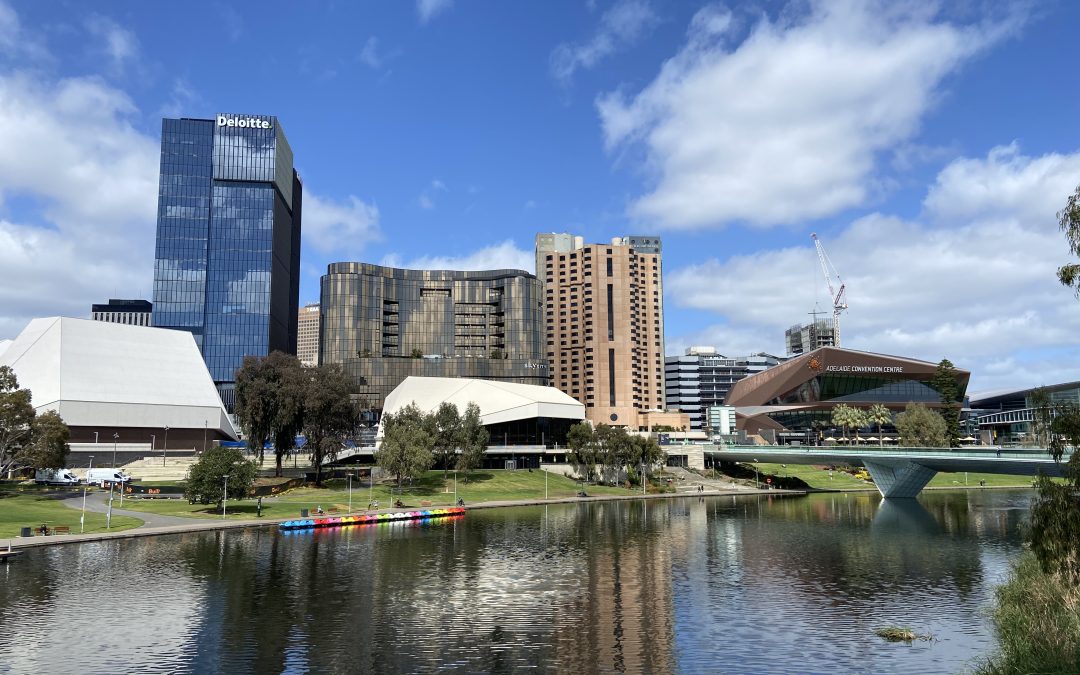
Adelaide Business Culture: Why the City Doesn’t Follow the Rules
Table of Contents
- Where Australia Sits on Erin Myer’s Culture Map
- The Adelaide Exception: What Makes It Different
- The Southern European Thread in Adelaide’s Business Culture
- Does the Evidence Support the Hypothesis
- Rethinking the Low-Context Assumption for Adelaide
- What This Means for Leaders in Adelaide
- The Bigger Picture
There’s a paradox at the heart of Adelaide business culture, and if you’ve moved there from interstate or overseas and found yourself on the outside of invisible networks you couldn’t quite locate, let alone join, you’re not imagining it.
According to the dominant frameworks of cross-cultural business — Erin Meyer’s The Culture Map — Australia should be one of the easiest places on earth to build professional relationships. Direct. Task-oriented. Low on ceremony. Yet talk to anyone who has tried to crack Adelaide’s business community from the outside, and you’ll hear a very different story. The city is warm and liveable, yes. But it can feel oddly closed: a place where the deals have already been done between people who went to the same school, whose families shared the same table at a social club in Thebarton or Mile End, or who simply grew up in a city small enough that everyone already knows everyone else.
This post explores that tension: where Australia sits on Meyer’s Culture Map, what that predicts about doing business here, and why Adelaide (quietly, stubbornly) doesn’t quite behave the way the theory says it should.
Where Australia Sits on Erin Meyer’s Culture Map
Erin Meyer’s The Culture Map plots countries across eight dimensions of workplace culture. For understanding Adelaide business culture, two dimensions matter most: communicating (low-context to high-context) and trusting (task-based to relationship-based).
Australia is firmly in the low-context, task-based quadrant. In fact, alongside the United States and Canada, it’s one of the most low-context cultures in the world.
What Low-Context Communication Looks Like
In a low-context culture, communication is explicit, direct, and meant to be taken at face value. There are no layers to decode, no need to read between the lines, no elaborate protocol before you can say what you mean. Messages say what they mean. This is partly a product of Australia’s history: a nation built through successive waves of immigration, where explicit communication was a practical necessity across groups that didn’t share a common background of assumptions.
For leaders, this is relevant beyond just how we talk to colleagues. It shapes how we navigate difficult conversations at work, how we give feedback, and how quickly we can establish credibility with a new team. In a low-context culture, directness isn’t rude, it’s expected.
What Task-Based Trust Looks Like
In a task-based trust culture, trust is built through demonstrated competence and reliable delivery. You earn credibility by doing what you said you’d do, on time, to a good standard. Personal relationships are secondary to performance.
This contrasts sharply with relationship-based cultures (e.g. Brazil, China, Saudi Arabia, Nigeria) where trust requires personal bonds that precede any business transaction. INSEAD research on trust-building across cultures confirms that in relationship-based cultures, trust is a feeling built over time through shared experiences, whereas in task-based cultures, it’s closer to a calculation based on track record.
By that logic, Australia should be easy to break into. Pitch up, demonstrate your competence, and get on with it. No political manoeuvring, no elaborate networking rituals.
So why doesn’t it feel that way in Adelaide?
The Adelaide Exception: What Makes It Different
Adelaide is Australia’s fifth-largest city, with a population of roughly 1.4 million. It also has one of the highest rates of population concentration of any Australian state: around 67 per cent of South Australians live within the Adelaide metropolitan area. This matters more than it might seem.
The Small City Network Effect
When a business community is small and dense, the network effects that operate at a national level in big cities operate at a personal level in smaller ones. In Sydney, you might circulate through dozens of overlapping professional networks without ever encountering the same person twice. In Adelaide, the business community is close enough that you will run into the same people at every event, in every precinct, across every industry. Everyone knows everyone. And more importantly, everyone already knows who everyone else is before you walk in the door.
This creates a fundamentally different social logic. Not because Adelaide’s culture has been deliberately designed to exclude, but because the sheer physics of a small, concentrated city mean that existing relationships dominate every room. The question for any newcomer isn’t just whether they can demonstrate competence (the task-based threshold) but whether they can find a way into a social fabric that’s been woven tight over decades.
This dynamic has a direct impact on leader integration. New leaders stepping into Adelaide organisations aren’t just managing a team; they’re navigating a web of pre-existing relationships, informal hierarchies, and unspoken allegiances. Getting that transition right from day one is genuinely harder here than in a larger, more fluid city.
The Southern European Thread in Adelaide’s Business Culture
Here’s where the hypothesis gets genuinely interesting, and where history adds a layer the Culture Map doesn’t fully capture.
Adelaide has a significant and historically deep Southern European community, particularly Italian and Greek. Italian settlers arrived as early as 1839, but the largest waves came after World War II, when Adelaide became one of Australia’s primary destinations for European post-war migration. You can read more about those communities at Italians in South Australia and Greeks in South Australia from the SA History Hub.
Greek communities settled in the city’s western suburbs (Mile End, Thebarton, Torrenside) establishing churches, community clubs, and the kafenia (coffee houses) that were far more than places to drink coffee. They were the social infrastructure of business: where deals were discussed, reputations built, relationships maintained, and trust established.
Southern European cultures are, on Meyer’s scale, considerably more relationship-based and higher-context than Anglo-Australian culture. Business is personal. Introductions matter. Shared history and social proof carry enormous weight. You don’t just do business with someone because they can do the job. You do business with people you know, or people known to people you know.
Over generations, this operating logic didn’t remain contained within those communities. It became part of the texture of how Adelaide does business more broadly.
Does the Evidence Support the Hypothesis?
The short answer is: yes, with nuance.
There is no single academic study that declares “Adelaide is more relationship-based than Sydney.” But the evidence, taken together, is compelling.
Adelaide’s business community is consistently described (by those inside and outside it) as “tight-knit.” That phrase appears in business profiles, in accounts from interstate transplants, and in the way networking organisations in the city talk about themselves. The City of Adelaide’s own business development materials emphasise relationship-driven commerce and note that connections “extend beyond the boardroom.” The wine industry (one of Adelaide’s defining economic clusters) has built its entire commercial infrastructure around events, shared experiences, and relationship networks.
Structurally, academic research on small and medium-sized cities documents what we might call the proximity paradox: geographical and social closeness accelerates knowledge transfer and builds strong industrial clusters, but it can also create “organisational lock-in”, a kind of insularity where existing networks become self-reinforcing and resistant to newcomers.
Rethinking the Low-Context Assumption for Adelaide
This brings us to a genuinely useful insight for anyone navigating Adelaide’s business landscape: low-context doesn’t necessarily mean easy to break into.
The standard framing positions low-context, task-based cultures as accessible and relationship-based cultures as difficult. And at the national level, and in large metropolitan centres, that’s often true. But at a regional level, other factors can override the national cultural baseline.
City size creates relationship gatekeeping
When the community is small enough, personal relationships become structurally necessary. Not because the culture demands them philosophically, but because everyone is already connected and the fastest path to any opportunity runs through an existing relationship.
Immigration heritage creates cultural micro-climates
Where Southern European communities have been large, prosperous, and economically active over multiple generations (as in Adelaide) their relationship-based business norms can become embedded in local business culture well beyond those communities themselves.
Industrial specialisation raises the stakes
Adelaide’s key industries (defence, wine, healthcare, professional services) operate as tight clusters where reputation and relationships matter enormously. These are not industries where you win work through a cold pitch; they’re industries where trust is built over time and referrals carry significant weight.
What This Means for Leaders in Adelaide
If you’re leading a team, building a business, or transitioning into a new role in Adelaide, the practical implications are clear.
Don’t assume task-based means you can skip the relationship-building. In Adelaide more than most Australian cities, the relational infrastructure matters. People want to know who you are, not just what you can do. And more specifically, they want to know who else knows you. Social proof and credible introductions open doors here that a cold approach often won’t.
But don’t mistake Adelaide for a high-context culture, either. The communication style remains direct. People say what they mean. You won’t need to navigate elaborate layers of subtext or observe ritualised formalities. When conflict arises (and in tight-knit environments it often does) Adelaide workplaces respond well to direct, structured approaches to resolution. Our conflict management work in South Australian organisations reflects this: candid but not confrontational, structured but not bureaucratic.
Think of it this way: Adelaide requires you to demonstrate both task-based reliability and social embeddedness. Competence is table stakes, but so is presence in the network. The good news is that the network is small enough that consistent engagement pays off relatively quickly. The less good news is that if you’re starting from zero, getting that first foothold takes more intentional effort than it might in a larger city.
The Bigger Picture
Adelaide is, in many ways, a fascinating case study in how cultural frameworks apply; and where they need to be supplemented by ground-level observation. Erin Meyer’s Culture Map is an extraordinarily useful tool for navigating cross-cultural difference, and Australia’s placement as a low-context, task-based culture is accurate at the national scale.
But culture is not monolithic. It varies by region, by industry, by city, and by the particular histories that have shaped local communities. Adelaide’s Southern European heritage, its small-city network density, and its tight-knit industrial clusters have produced something that looks, from a distance, like standard Australian business culture, but that operates with some importantly different underlying rules.
For leaders and businesses working across the Australian market, that’s worth knowing. The approach that works in Sydney may need to be recalibrated for Adelaide, not dramatically, but meaningfully. The relationships you build here are likely to be more durable, more community-embedded, and more central to long-term success than a purely task-based logic would suggest.
Adelaide rewards patience, presence, and genuine community investment. In that sense, it might just be the most interesting city in Australia to lead in.
Want to explore how these dynamics are shaping your team or leadership transition? Get in touch with Sun Dog Consulting — we work with leaders across South Australia to build the relational and cultural intelligence that drives real performance.
Or browse our full resources library for more insights on leadership, culture, and team dynamics in the Australian context.
Related reading:
- Why HR Is Drowning in Employee Relations Cases — and What Leaders Can Do
- Mastering Difficult Conversations at Work
- Redefining Leadership Development
Based in Adelaide, Sun Dog Consulting specialises in helping organisations build psychologically safe, high-performing cultures through personalised manager coaching and practical training programs.
If you want to talk about executive coaching, just reach out by giving us a call, book in a free consult or send us an email and we will get back to you.
More From This Category
No Results Found
The page you requested could not be found. Try refining your search, or use the navigation above to locate the post.